Most of us probably don’t drive vehicles that require diesel fuel. Consumers are much more familiar with watching the price of regular unleaded gasoline, or, increasingly, the cost of charging an electric vehicle. But diesel plays an important role in the broader economy, and changes in its price can ultimately affect the cost of everyday goods, should not be overlooked.
Think about something as simple as a can of corn. Diesel touches it at nearly every stage. A farmer uses diesel-powered equipment to plant and harvest the corn. Diesel-powered trucks haul it to a grain elevator and eventually a processing facility. Trucks also deliver the materials needed for packaging, including the cans themselves. Once canned, the corn is transported by truck to a distribution center and, ultimately, to a grocery store.
Our chart for this month illustrates U.S. distillate fuel oil inventories, as reported by the U.S. Energy Information Administration (EIA), part of the Dept. of Energy (DOE). Distillates include diesel fuel, which accounts for the majority of U.S. distillate consumption, as well as products such as heating oil. Tracking the inventories can provide insight into the supply-and-demand dynamics that influence diesel prices. And, by extension, help explain some of the potential inflationary implications occurring throughout the economy.
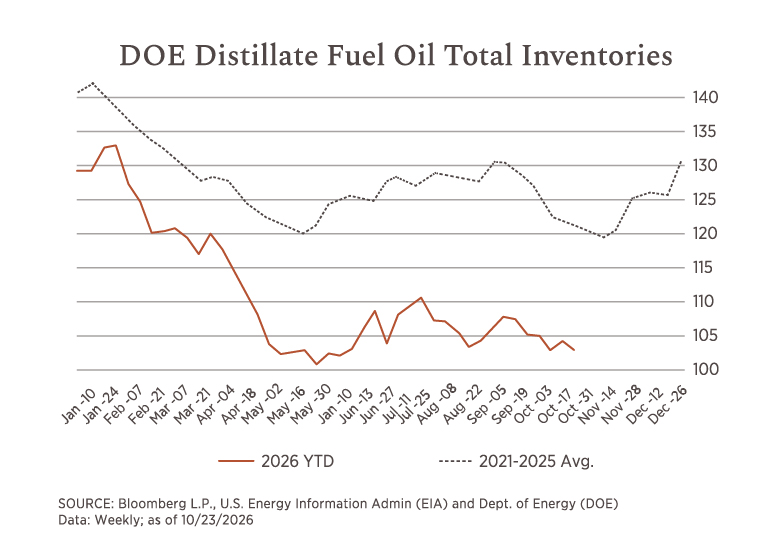
The red line shows inventories YTD in 2026 compared with the average of the prior five years (2021 – 2025). The most obvious takeaway is just how low the inventories have become, falling below their five-year average beginning this spring amidst the disruptions from the Middle East. We even took this back further to 2006 in our own analysis, and inventories sit at their lowest point at this time of year in the last two decades. Generally, inventories would rise during the summer in anticipation of fall and winter demand, but that has failed to materialize in 2026.
Why? It comes back to Economics 101: Supply and Demand.
Supply in this situation refers not only to the supply of crude oil, but also the global capacity available to refine oil into products such as diesel. The ongoing conflicts in both Russia/Ukraine and the Middle East have been a disruption. U.S. refineries have actually been running at high utilization rates, but global shortages have created an incentive to export more U.S.-produced fuel and thus keep domestic inventories tight (as the chart shows).
One effect of this has been higher diesel prices. Per the American Automobile Association (AAA), the national average for diesel is $6.32/gal (as of 10/29/2026), and it has been above $6/gal since early September. The knock-on effect is that the cost of transporting everyday goods also rises, and that additional cost must either be borne by the businesses through lower margins or passed along to the end consumer through higher prices.
As we think about inflation or other cost pressures affecting the economy, these less visible parts of the supply chain can provide important clues to get a sense on the future path for inflation, monetary policy, and economic growth.

Year-End Resources