What Is a QCD?
If you have investments in tax-deferred retirement accounts, such as traditional IRAs and employer-sponsored retirement plans, you may need to take annual required minimum distributions (RMDs) once you reach age 73 (or age 75 if born after 1960). These RMDs begin as a relatively small percentage of your retirement assets but increase over time as you age, potentially creating a higher tax burden and possibly even pushing you into a higher income tax bracket or affecting your eligibility for certain tax benefits.
For owners of eligible IRAs, qualified charitable distributions (QCDs) may provide a way to satisfy some or all of those RMD obligations while excluding the distribution from taxable income. QCDs are a special provision in the tax code that allows eligible IRA owners to make tax-free gifts of up to $111,000 for tax year 2026 (indexed for inflation) directly to qualified charities.1
In addition to reducing taxable income by up to $111,000, QCDs may allow charitably inclined individuals to support organizations they care about in a tax-efficient manner. Because QCDs are excluded from income rather than claimed as an itemized charitable deduction, they may also provide benefits for taxpayers who do not itemize deductions.
What Are the Potential Benefits?
Examples
To better understand how they work and their potential benefits, consider the following two scenarios. In both cases, the IRA owner is required to take a Required Minimum Distribution of $100,000 from their IRA and wants to give that entire amount to a qualified charity.
Scenario 1
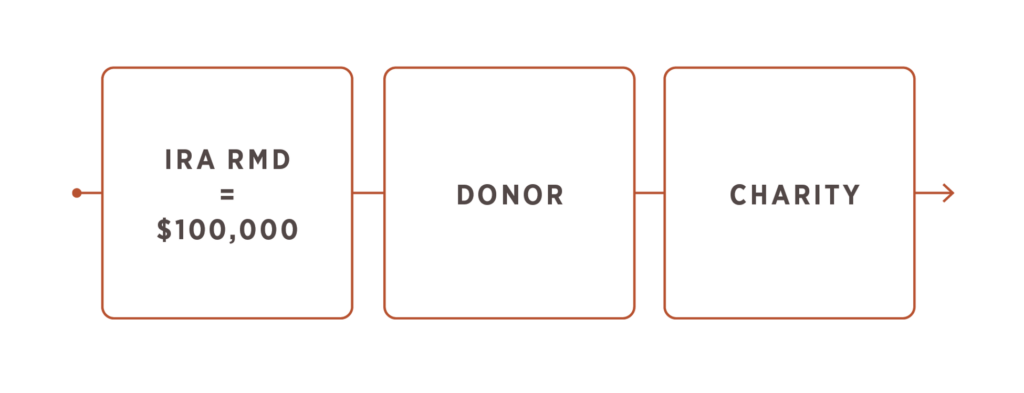
Donor takes required minimum distribution from IRA, then donates it to charity
- The RMD is distributed to the IRA owner
- The owner writes a check to charity
- The entire distribution is added to the IRA owner’s gross income for that tax year and can be added to schedule A as an itemized deduction subject to a limitation of 60% of adjusted gross income (AGI)
- If the owner’s standard deduction—$32,200 in 2026 (married filing jointly), plus $1,650 for those over the age of 652—is greater than the total of all itemized deductions, there is no tangible tax benefit for making the donation
- The IRA owner can still itemize other charitable donations on Schedule A if advantageous
- Certain other deductions may be limited / reduced due to the owner’s higher AGI
Scenario 2
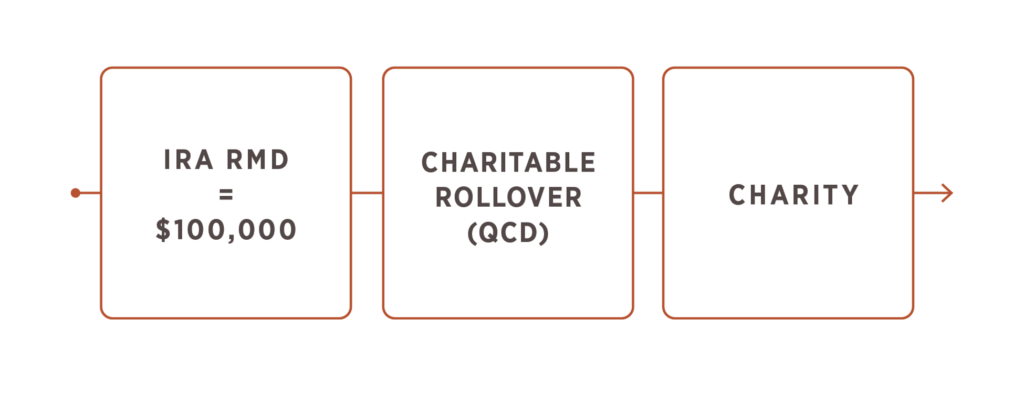
Donor distributes required minimum distribution directly from IRA to charity
- The RMD is distributed directly from the owner’s IRA to the charity
- The owner’s RMD is satisfied, and the distribution is not included in the owner’s taxable income
- This particular donation is not itemized as a deduction on Schedule A (Form 1040 or 1040-SR) because it has already been excluded from taxation
- The donation may help reduce taxes on the owner’s Social Security income and prevent the loss or reduction of certain other deductions
- Other gifts to charity may still be itemized on Schedule A if advantageous
One-Time Additional $55,000 QCD
It’s important to also note that as of tax year 2023, retirement account owners who are 70 ½ and older may also make an additional one-time $55,0003 distribution directly from their retirement account to a charitable gift annuity, charitable remainder unitrust (CRUT) or charitable remainder annuity trust (CRAT), which they can treat as a QCD made directly to a charity for tax purposes. And this amount counts toward the owner’s RMD, if applicable.
A charitable gift annuity is a contract you can enter with certain nonprofits, whereby you (the donor) make a large gift to the nonprofit and in return can take a tax deduction and receive a fixed stream of income from the charity for the remainder of your life.
CRUTs and CRATs are gifts you (the donor) can make to a trust that can provide you income for a set number of years, or for the rest of your life, after which a named charity receives the trust’s remaining assets.
For more information about any of these charitable giving structures, talk to your financial advisor.
Who Might Benefit from a QCD?
- Retirees who have pretax accounts and are charitably inclined
- Retirees who potentially stand to lose certain deductions due to the increase in their adjusted gross income caused by their RMD
- Retirees who don’t itemize their deductions because their combined itemized deductions, including charitable donations, are less than the standard deduction
Additional QCD Considerations
Please note that the above applies to federal income tax only. You should also carefully consider state taxes with your financial and tax advisors.
Also, it’s important to keep the following limitations and restrictions related to QCDs in mind:
- As previously mentioned, the distribution must be made directly from your retirement account to the qualified charity.
- You cannot transfer the distribution to donor advised funds or private foundations.
- Other than the one-time additional $55,000 QCD discussed above, QCD distributions cannot be made in exchange for a charitable gift annuity or into a charitable remainder trust.
- Deductible IRA contributions made after age 70½ continue to reduce the amount eligible for Qualified Charitable Distributions (QCDs). While the SECURE Act removed the age cap for making traditional IRA contributions, it also introduced a rule that offsets QCD eligibility by the cumulative amount of post-70½ deductible contributions. This provision remains unchanged under SECURE 2.0.4
- As a reminder, QCDs cannot be deducted as charitable contributions on Schedule A.
Conclusion
QCDs can be a very effective charitable giving strategy, but they require skilled consideration. Please reach out to us, and we can coordinate with your other advisors, including your accountant and tax attorney, to determine if making a QCD is the right strategy for you.
1. Qualified Charitable Distributions from Individual Retirement Accounts (IRAs). (n.d.). Congress.gov | Library of Congress. Retrieved May 29, 2026, from https://www.congress.gov/crs-product/IF11377
2. Taylor, K. R. (2026, February 21). The extra standard deduction for people age 65 and older: How much can you save? Kiplinger. https://www.kiplinger.com/taxes/extra-standard-deduction-age-65-and-older
3. Adams, H. (2026, January 20). Reducing RMDs with QCDs. Schwab Brokerage. https://www.schwab.com/learn/story/reducing-rmds-with-qcds
4. Accounting Insights Team. (2025, June 26). SECURE Act 2.0: Key Provisions and Changes – Accounting Insights. Accounting Insights. https://accountinginsights.org/secure-act-2-0-key-provisions-and-changes/