For some ultra-high-net-worth individuals, their wealth has accumulated greatly from concentrated stock positions. A concentrated position is an investment portfolio where a significant portion of an individual’s wealth is held in a single stock or a small number of stocks. This is a reality for many business owners who hold a significant number of shares of their company’s stock, employees who receive employee compensation, or individuals who have received an inheritance or have a single successful investment in their portfolio.
Although a concentrated stock can bring significant wealth, it can also present the risk of losing wealth without the right strategies in place. Below, we detail the risks of concentrated positions and give guidance on the different strategies to use to help manage these risks.
Why Concentration Can Undermine Long-Term Outcomes
One of the most persistent myths in investing is that skillful stock selection consistently beats the market. In reality, most individual stocks underperform their benchmark indexes on a risk-adjusted basis over both short and long-time horizons. Even the stocks that do outperform tend to struggle to sustain their leadership, often lagging in subsequent periods.
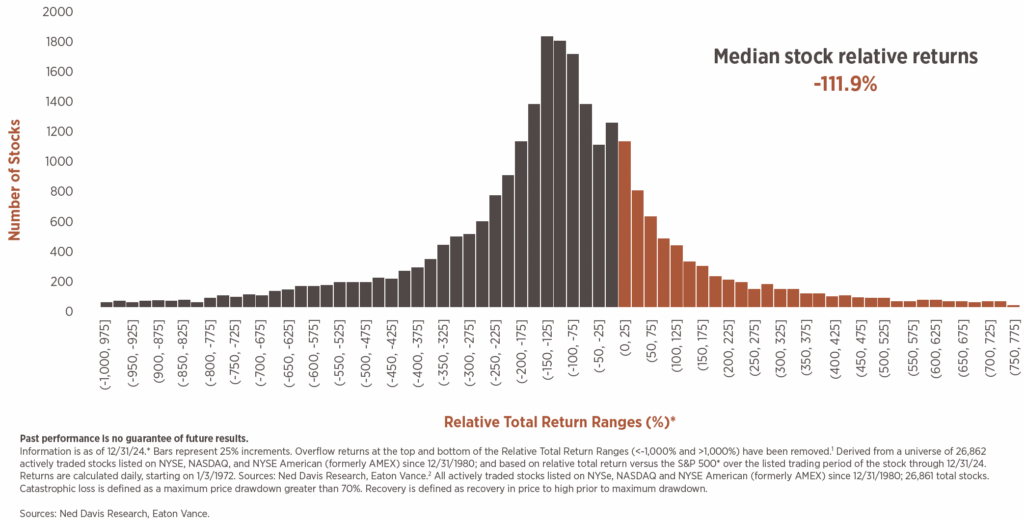
When investors concentrate portfolios around these perceived winners, they frequently underestimate the risks involved, leading to higher volatility and the potential for meaningful drawdowns.
Concentrated stock positions are inherently risky because portfolio outcomes become tied to the fate of a single company. Historical data from the Russell 3000 Index dating back to 1980 shows that more than 40% of companies experienced a catastrophic stock price loss—typically defined as a 70% decline from peak levels that was never recovered—often resulting in a near-total loss of capital.1
For those with concentrated positions, this underscores the importance of managing exposure thoughtfully. While diversification remains a cornerstone of portfolio construction, practical considerations such as taxes, liquidity needs, and employer restrictions often require more deliberate approaches.
Strategies for Managing Concentrated Stock Risk
Once the risks of concentrated stock positions are understood, the next step is determining how to manage them in a thoughtful and practical way. For many investors, selling a large stock position outright may not be feasible due to tax considerations, timing concerns, or personal circumstances. The strategies below highlight different approaches investors can use to gradually reduce concentration risk while balancing diversification, taxes, and long-term financial goals.

Aligning Strategy with Your Financial Journey
While these strategies provide a strong foundation for understanding how to manage a concentrated stock position, the most appropriate approach ultimately depends on who holds the stock and where they are in their financial journey. An entrepreneur may remain concentrated to preserve control and long-term upside, a long-term investor may hold based on conviction and tax efficiency, an inheritor may prioritize diversification and simplicity, and a corporate executive or founder—particularly one preparing to leave a company—may choose to reduce exposure as influence over company decisions declines and personal financial goals evolve.
Because concentrated stock positions intersect with taxes, liquidity, career considerations, and personal objectives, there is no one-size-fits-all solution. This is why having a thoughtful conversation with a financial advisor is essential. Our advisors help evaluate these strategies within the context of your broader wealth, risk tolerance, and long-term objectives. Connect with us to discuss integrated approaches to managing concentration risk and enhancing after-tax outcomes.
1. Turn concentrated stock risk into potential tax-savings reward. (n.d.). Retrieved January 4, 2026, from https://am.jpmorgan.com/us/en/asset-management/adv/investment-strategies/separately-managed-accounts/tax-managed-solutions/concentrated-stock-risk/