What is a Budget?
A budget is a written plan that helps you keep track of how much you earn (your income) and how much you spend (your expenses). It’s perhaps the single most important tool for understanding how to manage your money, because it clarifies exactly where your money is going. You can also use your budget to figure out how much you can save and invest.
It’s important to take the time to set up your budget accurately, so you can effectively track your spending.
Here are the key steps to take when planning your budget.
Step 1: Plan
Planning a budget involves identifying your income and figuring out spending priorities and tradeoffs. Essentially, you’re establishing a cash flow plan that lets you know how much you can spend each month—and how much you can save.
First, divide your expenses into two categories.
A simple but effective way to look at your expenses is to divide them into non-discretionary (your needs) and discretionary (your wants) categories.
- Non-discretionary expenses are the mandatory expenses, such as your mortgage or rent, groceries, transportation, insurance premiums, and taxes. Be sure to include debt payments such as credit cards and auto loans. You may find it helpful to include your savings and investing goals as line items in your non-discretionary category (e.g., retirement savings, education expenses, or medical care costs).
- Discretionary expenses are your “wants” rather than “needs,” such as restaurants, entertainment, travel, and even clothing.
Don’t forget to set aside money for upcoming big-ticket items that come once or twice a year, such as insurance premiums and real estate taxes.
Next, list your sources of income.
Your regular wages are most likely your primary source of income. However, you may have other sources such as bonuses, gig work, gifts, income from rental property, interest or investment income, and government benefits, for example.
Step 2: Create
Now, it’s time to start inputting the numbers into your plan. Add up your discretionary and non-discretionary expenses and deduct them from your monthly income after taxes.
If you are left with a negative number, you will need to prioritize your expenses in order to reach your goals. Think about if you can cut back on entertainment expenses or make small adjustments like taking public transportation instead of driving in order to be back in the positive range. These are all slight adjustments you can make to your routine to help you save money.
Step 3: Keep Track
Keeping your budget up to date and sticking to it are often the hardest parts of budgeting, but they’re also the keys to success. Therefore, you want to make sure you are monitoring it regularly.
If you’re having trouble sticking to your plan, try using a spending tracker to record your purchases each day for a week. This can show you exactly where your money is going and help you spot areas where you might want to adjust.
A Simple Way to Divide Your Money
One way to make budgeting more manageable is to break your income into a few core categories. By setting general targets for essentials, long-term savings, and short-term needs, you can create a structure that helps keep your spending and saving in balance.
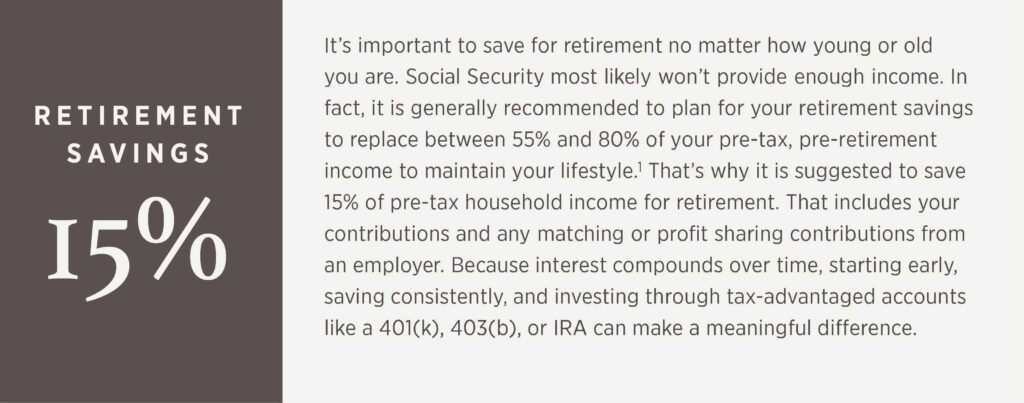
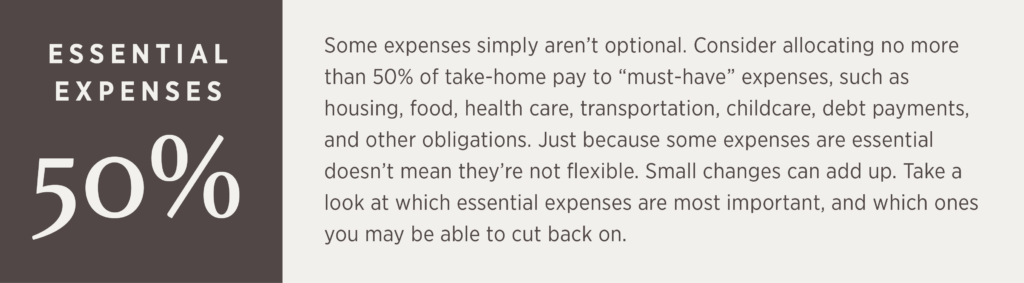
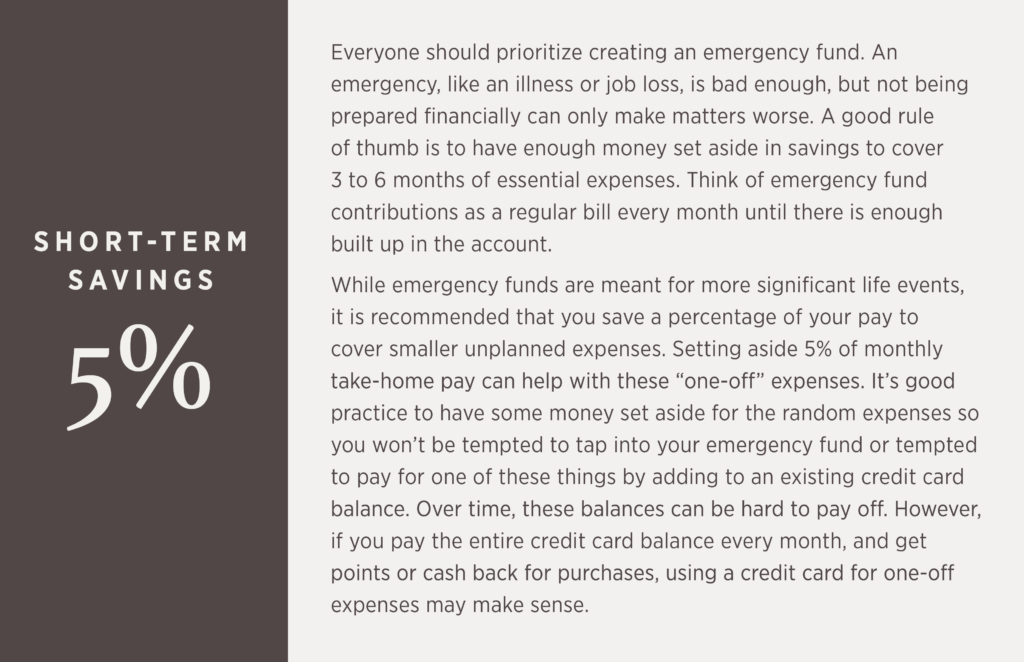
These guidelines are intended to serve as a starting point. It is important to evaluate your situation and adjust as necessary. Analyzing current spending and saving based on these categories can give you control and confidence in your finances.
Everyone’s financial situation will change over time. A new job, marriage, children, and other life events may alter cash flow, so it’s a good idea to revisit spending and saving regularly.
Understand Checking and Savings Accounts
You can open up a basic checking and savings account at a bank or credit union to manage day-to-day expenses and short-term savings.
Checking accounts are used to store money in the short term until it is needed—like for gas, or groceries, or to pay bills. You can easily deposit or withdraw money through checks and/or debit cards.
Savings accounts are used to set money aside for use in the future—like for an emergency or a vacation—and enable the money to collect interest. While you can contribute money at any time to a savings account, unlike checking accounts there are limits on how often you can withdraw money.
Take the time to compare different financial institutions and find services and features that are right for you.
Directly depositing your paycheck and linking your savings and checking accounts can help you better manage your finances and may make it easier for you to save.
What to look for:
- A checking account that pays interest
- No-or low minimum balance requirements
- Unlimited free checking
- Free ATM withdrawals
- Good customer service
What to avoid:
- Monthly account servicing fees
- High fees for insufficient funds
- High account minimums
Bank apps and online tools are especially useful for visual learners, as they help you see where your money is going at a glance and receive real-time alerts when you’re at risk of going over your budget.
Establishing goals
As part of creating a budget, you want to think about what goals you want to eventually reach. Maybe, it’s a down payment on a house, a new car, or to live comfortably in retirement. These goals vary from person to person, so take time to think about what’s most important to you and what you want your money to achieve.
Once you’ve determined your goals, write them down. Think of them as a road map, with you taking one step at a time toward your destination.
Here’s a simple two-step approach:
- Divide your goals into three categories: short term (less than one year), medium term (one to five years), and long term (more than five years).
- Attach a dollar amount to each goal. For instance, a short-term goal for you might be a summer vacation. Think about how much it will cost. The more specific you are about your goals, the more motivated you’ll be to work toward them.
Decide how much you can put toward each goal per month. Then use your budget to help you estimate how long it will take to reach each goal. Be sure to track your progress regularly to help you watch your savings build toward a goal.
Budget Worksheet
Included in this PDF is a list of all the possible expenses you might encounter. All may not apply, but this can give you a good framework to determine “must-haves” vs. things to cut.
Conclusion
There isn’t a single, one-size-fits-all solution for creating and maintaining a budget. Financial professionals also know this and can help craft a strategy suited to your goals and financial situation.
1. What will my savings cover in retirement? (2025, August 28). Fidelity. https://www.fidelity.com/viewpoints/retirement/retirement-income-sources